

A knife can be razor sharp and still cut badly. In a kitchen knife, geometry is the shape of the blade behind the edge: how thin it is, how quickly it thickens, and how cleanly that cross-section passes through food. For everyday cutting, that geometry usually matters more than the small differences between good modern knife steels. Steel, hardening and the edge all still matter, but geometry is what decides whether a knife parts food cleanly or wedges it apart.
What does knife geometry mean?
Geometry here is not the outline of the blade, the length or the shape of the tip. It is the cross-section: what the blade would look like if you sliced through it and looked at the end. The number that matters most is how thick the blade is just behind the edge, and, almost as much, how quickly it thickens from there into the body.
That second part is the one most people miss. Good geometry is not a single measurement. It is a curve. A blade can be thin at the very edge and still fat a few millimetres up, at which point it starts shoving food aside rather than parting it. What you want is thinness that is carried back into the blade, not just a fine edge sitting on a thick body.
Our answer to that is a concave, or hollow, grind, which we will come to. First, why any of this matters (because it does!)
Why can a sharp knife still cut badly?
The edge is only the very front of the blade. Behind it sits the body of the knife, and that is what has to pass through the food once the edge has started the cut. A blade passing through food has to push that food aside, and the more abruptly it thickens behind the edge, the more sideways force is needed to do it. Thin behind the edge means less shoving, less resistance, and a cleaner cut. Thick behind the edge means the blade works like a wedge, and you feel it. Carrots fly all over the place rather than sit in a well-behaved row, post-slice.
A razor blade proves the point from the other direction. It can be extremely sharp, but it has none of the stiffness, height or working shape of a kitchen knife. Sharpness starts a cut. Geometry is what makes a usable knife.
An axe is the counter-example at the far end. An axe is deliberately thick behind its edge, because it is meant to split wood by force. A kitchen knife wants the opposite tendency: enough support behind the edge to survive daily use, and as little wedging as possible. A surprising number of kitchen knives sit closer to the axe than their makers would care to admit.
Why are most kitchen knives not ground this thin?
If thin behind the edge cuts so much better, the obvious question is why it is not universal. The answer is that it is harder, slower and less forgiving to make, to say nothing of considerably more expensive. Most kitchen knives are ground with flat or slightly convex faces running down toward the edge. Those shapes are easier to produce consistently, but they leave more metal behind the edge than a carefully controlled hollow grind does.
Taking that metal away takes time and precision, and it is easy to go too far and leave the blade weak. Mass manufacture sensibly favours a thicker, more robust grind that is cheap to produce and hard to damage, even though it cuts less well. The extra thickness is not really an accident. It is a tolerance for error built into the design.
How we do it
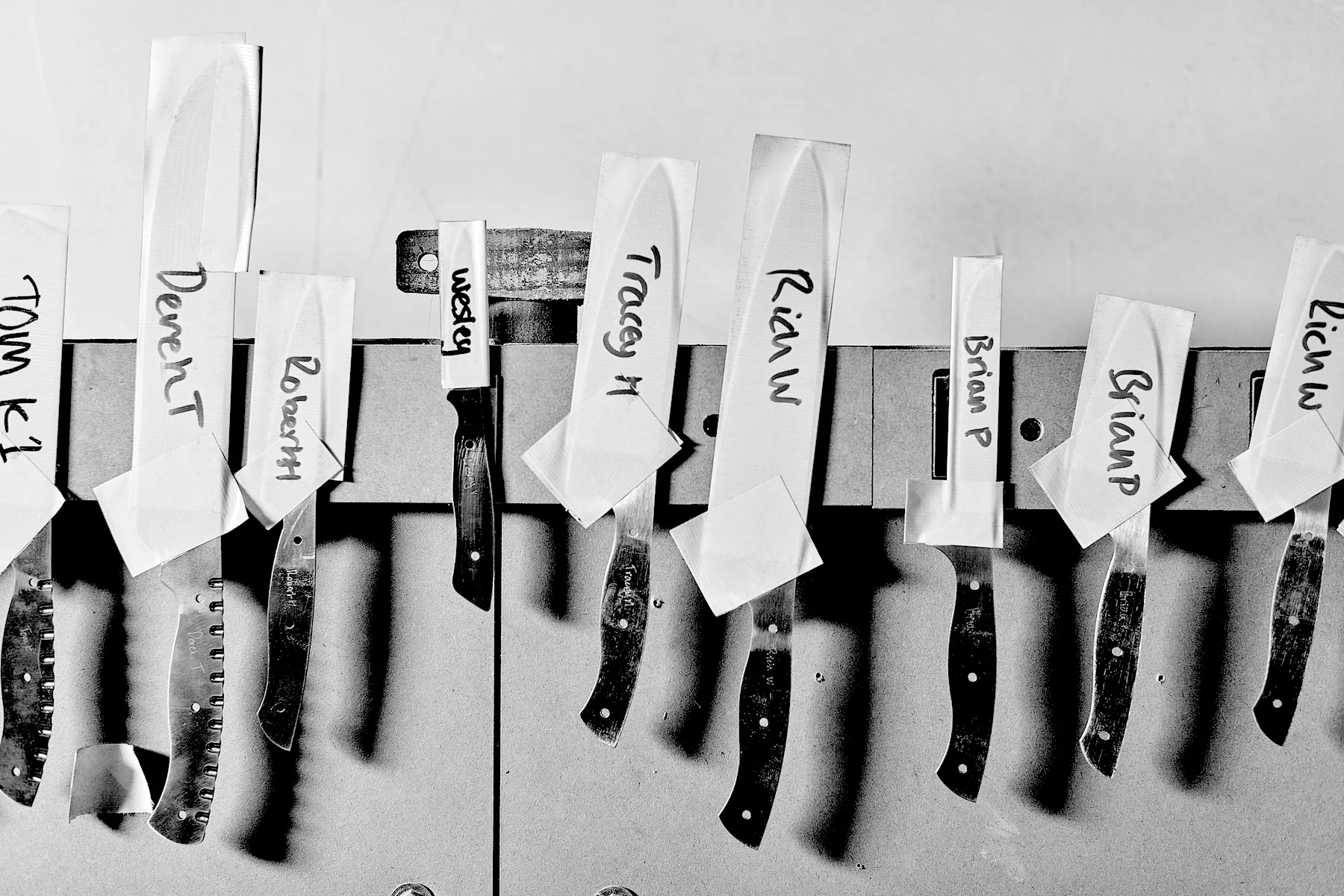
We machine our blades to a concave cross-section. Rather than grinding the faces flat, we CNC machine a shallow inward curve into each side, which removes far more metal from just behind the edge than a flat grind would, while leaving enough body higher up to keep the blade stiff.
The blade ends up around three tenths of a millimetre thick a single millimetre back from the edge, and roughly a quarter to a third of its weight is taken away in the process. The tolerances are borrowed from aerospace and Formula 1 work rather than ordinary cutlery production. It took us about three years to work out how to do it repeatably. As far as we have been able to establish, this kind of CNC machined concave grind is almost certainly unique in kitchen knifemaking.
We did not choose it to be unusual. We chose it because thinness behind the edge is the largest lever we know for making a kitchen knife cut cleanly, and we would rather pull that lever properly than leave performance on the table for the sake of an easier grind.
Does thin geometry make a knife fragile?
The reasonable worry is that a blade this thin must chip or bend. It would, if thinness were the only consideration. It is not.
Thin does not mean thin everywhere. The idea is to remove metal where it obstructs the cut, and leave enough behind the edge to survive real kitchen use. That balance only works when the grind, the steel and the hardening are chosen together. Get it wrong in one direction and thin becomes fragile. Get it wrong in the other and robust starts to feel blunt. The hardening side of that balance is its own subject, linked below.
How does good geometry feel in use?
You do not need to measure a blade to know whether its geometry is any good. You can feel it.
A knife with poor geometry does not simply feel blunt. It wedges. Hard vegetables crack or split before the blade has passed through them, slices stay joined at the bottom, the cut wanders off line, and bits skitter off the board. You find yourself pressing down harder than you should, which is both tiring and less safe.
Good geometry feels quieter. The edge starts the cut and the blade follows through without forcing the food apart. An onion opens cleanly rather than being crushed apart, and you notice how little you are having to lean on the knife. That quietness is the geometry doing its work.
The principle worth keeping
Sharpen a badly shaped knife and you have a sharp knife that still cuts badly. Get the geometry right and a sound working edge cuts better than a polished edge on a poorly shaped blade.
That is why we treat the shape of the blade as the foundation and the edge as the finish, rather than the other way round. Almost everyone looks at the edge. The difference is mostly behind it.