

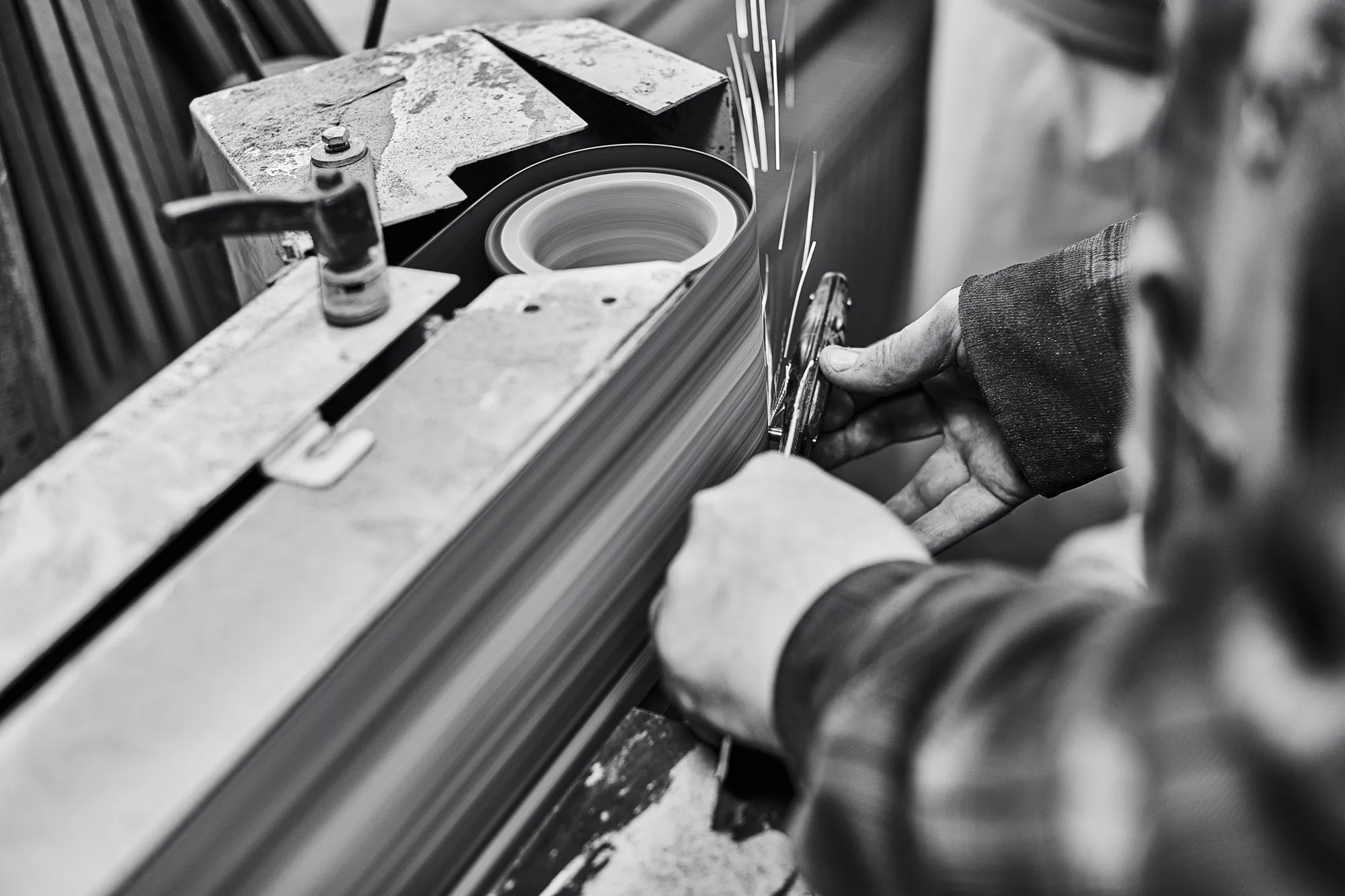
Forging is a method of making a knife, not a mark of quality. A well designed, precisely machined and properly hardened knife will outperform a poorly made forged one, and a well made forged knife will outperform a poorly made machined one. The word “forged” has come to be sold as a shorthand for quality, but it tells you almost nothing about how a knife cuts. That comes from geometry, heat treatment and the edge, however the blade was shaped in the first place.
What do forged and machined actually mean?
Forging shapes a blade by heating steel and hammering or pressing it into form, moving the metal around rather than cutting it away. It is the old, dramatic image of knifemaking: the glowing bar, the anvil, the sparks.
Machining, or stock removal, starts with a piece of steel and takes material away until the blade is the right shape, by grinding and cutting. Many modern kitchen knives are made this way, including very good ones. Our own blades are precision-machined and then hand-finished, not forged.
Both are legitimate. Both can produce an excellent knife or a poor one. Neither word, on its own, tells you which.
Why “forged” became shorthand for quality
Because it sounds old, skilled and difficult, and those things sound like quality. Forging carries centuries of romance: the smith, the fire, the hammer. It is a good story, and a good story is easy to sell.
There is a grain of history behind it. In older, less consistent steels, forging could help refine and consolidate the material as well as shape it. With modern clean, specified knife steels, that old advantage is much smaller. Forging may still be a legitimate way to shape a blade, but it is no longer proof that the finished knife will cut better.
What remains, in marketing, is often the image. Forging is now, for the most part, a way of shaping a blade, and sometimes of telling a story about it. It does not, by itself, make the knife cut better.
What actually decides how a knife cuts
The same things that always do. How thin the blade is behind the edge. How well the steel has been hardened and tempered. How the edge is finished. A forged blade with poor geometry is a poor knife. A machined blade with excellent geometry, hardening and edge work is not inferior because it was machined. The process that got the steel into shape is upstream of all the decisions that actually matter.
This is why we are not defensive about machining our blades. Precision is not the enemy of a good knife. It is how you get a blade thin exactly where it needs to be thin, held to tolerances that would be impossible by forging alone, repeated accurately every time. We would rather control the shape precisely than ask romance to stand in for repeatability.
Machines and hands, and where each belongs
None of this means people do not matter. It means using machines where machines are better, and hands where hands are better.
Machines are better at precision and repeatability: grinding a concave blade to the same exact geometry, again and again, without drift. Hands are better at judgement and finish: the feel of a handle, the final edge, the decisions that need an eye rather than a program. A good workshop uses both, honestly, and does not dress up the machine work as hand work, or the hand work as something it is not.
Are Savernake knives hand-forged?
No. You may see our process described elsewhere as “hand-forged”, but it is not. Our blades are precision-machined and hand-finished. We use machines where machines are better, and hands where hands are better, and we would rather be accurate about that than borrow a more romantic word we have not earned.
The principle worth keeping
Ignore the word and look at the knife. “Forged” is not a promise, and “machined” is not an insult. A knife is good because of its geometry, its hardening and its edge, not because of the noise the steel made while it was being shaped. Anyone leading with how their blade was formed, rather than how it performs, is asking you to buy the story before you have judged the knife.