

14C28N is a modern stainless knife steel from Sweden, developed by Sandvik, whose former materials business is now Alleima. It sits in the optimal band of kitchen steels: it takes a fine edge, holds it for a sensible time, is tough enough for normal kitchen use, resists rust well, and comes back to a keen edge without a fight. We use it on the great majority of our knives, hardened in-house to 60 HRC. For our knives, it balances the things that matter in a working kitchen better than flashier alternatives would. It is Swedish, and we say so plainly.
What is 14C28N?
It is a fine-grained stainless steel developed specifically for knife blades. Without turning this into a metallurgy lecture, it carries enough carbon to harden well and take a keen edge, enough chromium to give proper stainless corrosion resistance, and a little nitrogen that helps the structure stay fine and even, and also helps with corrosion resistance. The result is a steel that takes a keen edge and behaves in a stable, well mannered way, rather than one that is remarkable in any single direction.
That “well mannered” quality is the point. It is a steel that does everything a kitchen asks reasonably well, which is exactly what the optimal band is.
Why we use it
We chose 14C28N because it does everything a kitchen blade has to do at once, rather than winning on one measure and losing on the rest. That balance is the whole point of the optimal band, and it is where a working knife wants to be.
This is not a claim that the steel is where the knife is won. It is the opposite. Choosing a sound, predictable steel is what frees us to put our real effort into geometry, hardening and the edge, the parts that decide how the knife actually cuts. If another steel came along that gave a real gain in the finished knife, at the same cost and availability, we would use it without hesitation. The loyalty is to the outcome, not the ingredient.
How do we harden 14C28N?
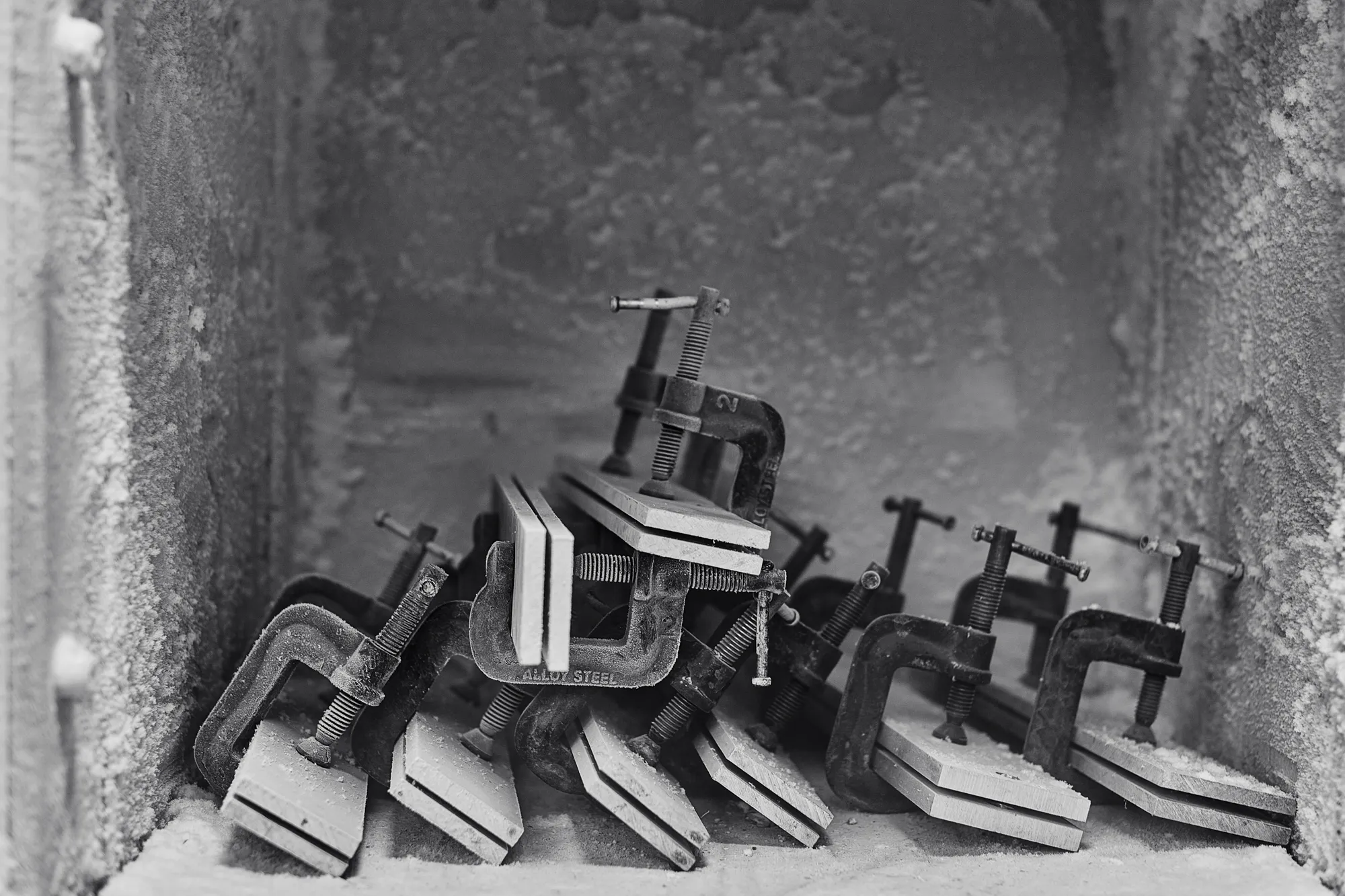
Steel is only potential until it is hardened, and 14C28N rewards careful heat treatment. We harden ours in-house to 60 HRC, with a cryogenic stage down to around minus 75°C, and we hold that hardness to a single figure rather than a vague range.
Sixty on the nose matters. A tight, specific hardness is a sign that the heat treatment has been properly controlled, and it is chosen to suit our geometry: hard enough to hold a fine edge, not so hard that the thin grind becomes fragile. How hardening and tempering actually work is its own subject, and one we will come to separately.
Is 14C28N British?
No. The steel is Swedish, developed by Sandvik and produced in Sweden by what is now Alleima. This matters because “British made” gets used loosely, and steel origin is the part most often blurred. Where a knife is designed, where it is made, and where its steel comes from are three separate things, and they are frequently allowed to run together so a buyer assumes all three are British when only one may be.
Good knife steel is a metallurgical speciality, and much of the best of it is not British. We would rather buy an excellent Swedish steel and say so than imply an origin that is not there. Our knives are made in Wiltshire. The steel they are usually made from is Swedish. Both of those things are true, and we see no reason to be coy about either.
The exceptions
14C28N is our standard, not our religion. A handful of knives use something else where it suits the job better. We will make blades in RWL34 on request, some of our sets use a Takefu San Mai construction, and one knife, the Tomato Knife, is made from a British steel. These are considered exceptions rather than a scattergun approach, and they exist because the right steel for a knife depends on what the knife is for. (Buyable details change, so check the current range for what is available.)
The principle worth keeping
14C28N is not an exotic choice, and that is exactly why we chose it. It is a sound, modern, honestly Swedish steel that does everything a kitchen knife needs and nothing to excess. We picked it for how it behaves in a finished knife, not for how it reads on a specification sheet, and we treat it carefully because a good steel treated badly is just a wasted good steel.